
Forestry Mulching vs Land Clearing: Which One Does Your Land Need?
Short answer: mulch when you want the growth gone and the ground left covered. Clear when you need bare dirt. Mulching grinds brush and small trees where they stand and leaves the chips down. Clearing takes the trees, stumps and roots out and hauls the wood off.
The price follows that same line. National cost guides put light mulching work near $500 to $2,000 an acre and heavy growth at $3,000 to $6,000. Those same guides put a full clear of lightly wooded ground around $580 to $2,300 an acre. Heavily wooded ground runs roughly $3,300 to $6,200. These are market numbers, not our price list.
What does forestry mulching leave behind?
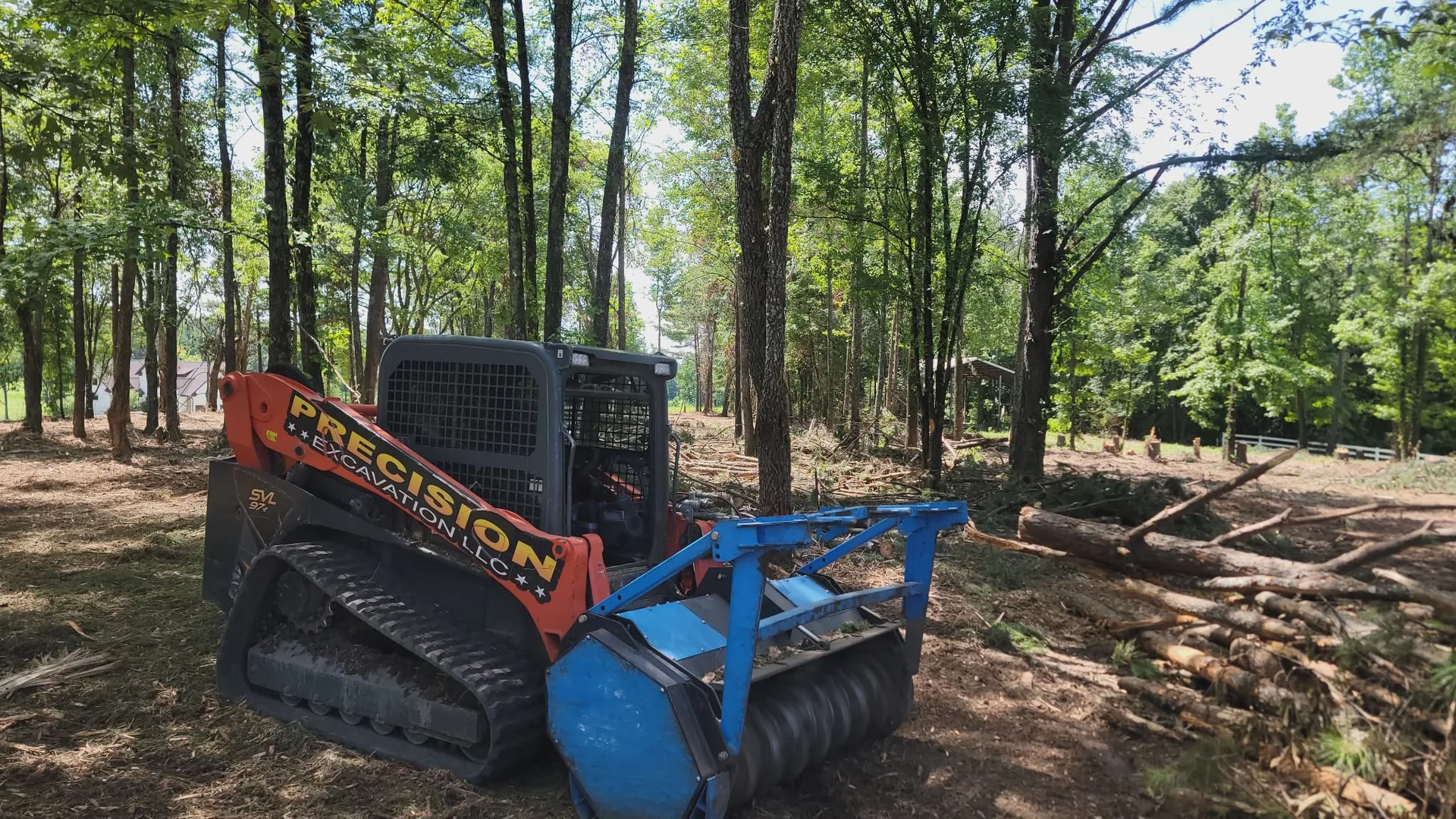
Forestry mulching runs a mulching head on a skid steer through standing brush and small trees. The head cuts the growth and shreds it into chips. The chips fall where the growth stood and settle into a mulch layer. One machine does the whole job in one pass.
That layer does real work on the dirt. Forestry extension guidance on mulching says the chips put nutrients back into the soil. It also says they hold moisture in the ground and even out soil temperature. On a slope the layer holds dirt in place through a hard rain.
What stays is the part people miss. The stumps and the roots are still down there under the chips. The ground is open and easy to get around on. It is not bare dirt, and it will not hold a building grade.
What does land clearing leave behind?
Land clearing takes the whole footprint down to dirt. The dozer pushes the trees over and piles them. The trackhoe pulls the stumps and the root balls out of the ground. The brush and the wood get loaded into dump trucks and hauled off.
What is left is rough graded dirt that will hold a grade, so a builder can work on it. Around here the trackhoe usually pulls stone up along with the roots. North Alabama sits on shallow limestone and chert.
Clearing moves far more material than mulching, and the price comes from that. Every stump is its own pull. Every load of brush is a truck trip. Before the digging starts we call Alabama 811. The service is free and the utility companies come mark their buried lines.
When should you mulch and when should you clear?
Mulch when the ground gets to stay ground. Understory under timber you want to keep is the common case here. Privet, honeysuckle, briars, sumac and pine saplings choke everything under the canopy. Pasture edges and fence lines grown up in cedar and sweetgum come next. Trails, shooting lanes and view corridors belong in that same group.
Clear when something has to get built or dug. A house pad, a shop building, a pond or a new driveway needs bare dirt that holds a grade. Big timber is past what a mulching head handles. Rock in the way has to come out of the ground, not get ground up.
Wet ground and steep slopes push the answer too. Forestry guidance says machine mulching may not suit sites with excessive slope or extreme wetness. Large rock that cannot be mulched rules it out as well. Either way, the grading afterward is dozer work.
How fast does the brush come back after mulching?
It comes back. Mulching cuts the top off and the root system underneath keeps living. How fast depends on what was growing before the machine got there.
Chinese privet is the one to plan around in North Alabama. The Alabama Cooperative Extension System says cutting alone does not give satisfactory control. Privet sprouts back from the stump too fast. Extension adds that after mulching or other mechanical work, privet sprouts from stumps and from lateral roots.
The upside sits in that same publication. Extension says brush mulching often leaves an even flush of privet regrowth that is easy to spray. It puts the best spray window at late fall to early winter. That is November through early January, while day temperatures are still mild. Spraying is not work we do, so most landowners handle that part themselves.
Clearing pulls the root out with the stem, so less is left to sprout. Seed still blows in and birds still drop it. Ground that gets mowed or grazed stays open. Ground that sits idle fills back in either way.
What happens to the wood and the debris?
Mulching never makes a pile. The chips break down into the dirt over the next few seasons. Most people mow over them once grass fills back in, or leave them alone out in the woods.
Clearing makes a pile, and that pile has to go somewhere. Our dump trucks haul it off the property. Burning it is the landowner’s call. Alabama law requires a burn permit from the Alabama Forestry Commission for agricultural and forestry burning. Fires under a quarter acre do not need one.
What drives the price on each one?
The drivers are mostly the same, with different weight on each. Stem size and how thick the growth is set the pace of a mulcher. Acreage, slope, wet ground and travel distance move both numbers. Clearing adds two more: how many stumps come out, and how far the debris gets hauled.
Published market ranges look like this.
| Job | Published market range |
|---|---|
| Forestry mulching, light brush and saplings | $500 to $2,000 per acre |
| Forestry mulching, small trees and thick brush | $1,500 to $3,500 per acre |
| Forestry mulching, heavy growth and big stems | $3,000 to $6,000 per acre |
| Forestry mulching, priced by the hour | $150 to $250 per hour |
| Land clearing, lightly wooded | about $580 to $2,300 per acre |
| Land clearing, heavily wooded | about $3,300 to $6,200 per acre |
| Stump removal, priced by the stump | $130 to $350 each |
Those figures come from national cost guides, and the guides do not agree with each other. One puts an average mulching acre near $400 while another starts its light range at $500. That gap is real. An acre of grass and saplings is not the same job as an acre of thick privet. These are market numbers, not our price list.
Which one fits your land?
Tell us what the land is for and we will tell you which one it takes. Plenty of jobs need both. Clear the building site and the driveway down to dirt, then mulch the back acreage and the fence lines. The same machines and trucks cover the whole property.
Estimates are free and we come look at the ground first. Call or text (256) 303-7210 to set one up. Read more about what a mulching job covers, or see the rest of the excavation and dirt work we do. We work out of Trinity and cover about 60 miles across North Alabama.